



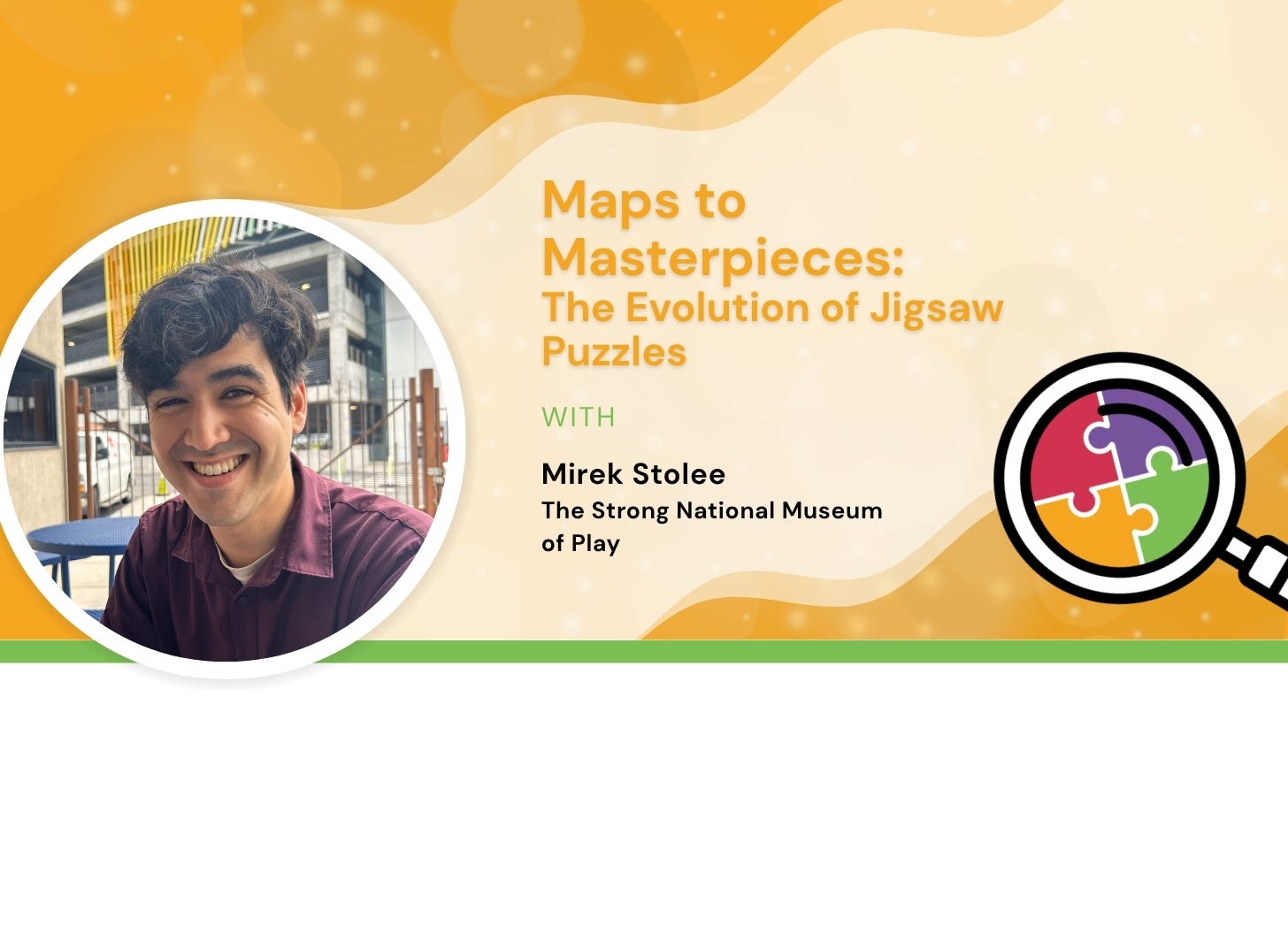
This week on Dissectologists, I sat down with Mirek Stolee, a curator at the Strong National Museum of Play, to talk about the history of jigsaw puzzles. We uncovered how puzzles evolved not just as objects, but as reflections of culture that are shaped by technology, labor, and even moments of global conflict.
In this episode, Mirek and I talk about:
The origins of jigsaw puzzles as 18th-century educational tools
How dissected maps became one of the earliest forms of puzzling
The evolution of puzzle manufacturing from hand-cut wood to die-cut cardboard
The role of treadle (sewing machine-style) cutting tools in scaling production
The Great Depression puzzle boom and the rise of home-based puzzle makers
Early speed puzzling competitions and the long history of competitive play
How puzzle imagery reflects cultural values across decades
Why puzzles continue to resonate in moments of societal change
If you’ve ever wondered where puzzles come from or why they feel so timeless, this conversation is for you.
“Puzzle booms tend to happen during moments of major societal change.”
Two things from this conversation have been sitting with me.
The first is something I hadn’t heard before.
At one point, Mirek described an early stage in puzzle manufacturing, before die-cut machines, where puzzles were cut using treadle-powered saws. Foot-pedal machines like a sewing machine.
These machines were often operated by women, and the way they were described, compared to sewing, wasn’t accidental.
It’s a small detail, but it opens up a different layer of the story. Puzzles were part of a system shaped by economics, gender, and access.
Then there was the second conversation.
We started talking about puzzle imagery during World War II, and the existence of whimsy pieces shaped like bombs and revolvers. War imagery in something we now associate with calm and quiet.
It felt… jarring.
Because today, puzzling is almost synonymous with relaxation (unless you’re a speed puzzler).
And yet, at one point, puzzles were carrying the tone of a very different cultural moment. One filled with tension, patriotism, and propaganda (deja vu anyone?).
Puzzle art is not just decoration. It has the potential to reflect, reinforce, and shape cultural narratives.
And maybe that’s the throughline of this entire conversation.
Puzzles are artifacts of what we value and what we’re living through.
And the more you look at them that way, the more they start to reveal a bigger picture.
Find The Strong National Museum of Play
Website: www.museumofplay.org


