



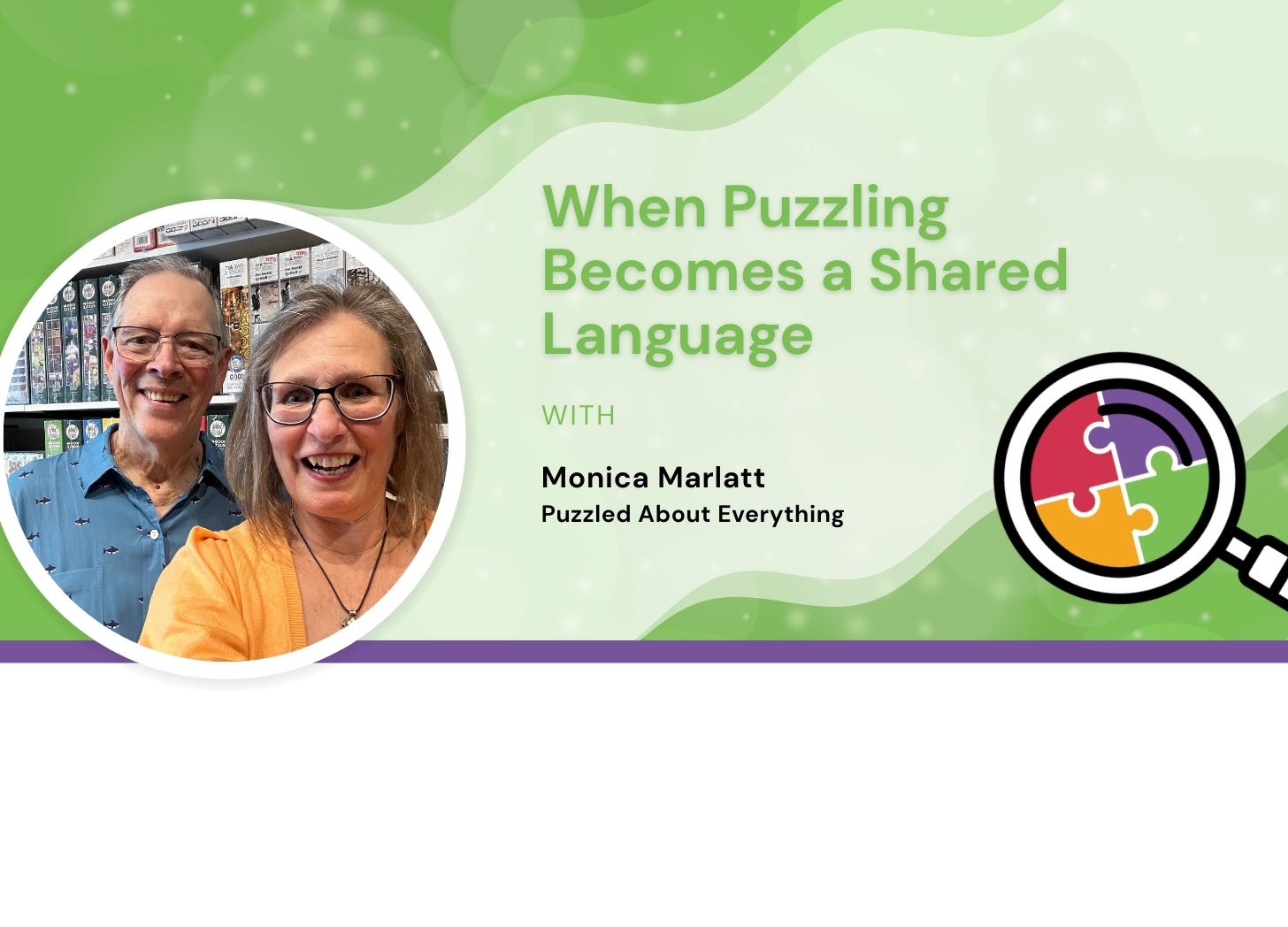
This week on Dissectologists, I sat down with Monica Marlatt from Puzzled About Everything, a puzzler who has taken her hobby from the dining room table to cruise ships around the world.
We talked about puzzling as connection. Not competition. Not speed. But community. And what happens when you start paying attention not just to the pieces on the table, but to the people around it.
In this episode, Monica and I talk about:
What it means to call yourself a “community puzzler”
Why 300-piece puzzles are often more powerful than 1,000-piece ones
How choosing the right piece count and image can change someone’s entire experience
The moment people say, “I forgot I liked puzzling.”
How puzzling as a couple reveals personality differences: sorting styles, space boundaries, patience
Why “It’s not who finishes. It’s who stays.”
How cruise ship puzzling turns strangers into trivia teammates and date-night partners
The dignity of accessible puzzles for seniors and returning puzzlers
If you’ve ever started a puzzle with someone else and realized you approach it completely differently, this conversation is for you.
“I’m a community puzzler.
It’s not who finishes.
It’s who stays.”
Monica doesn’t just host puzzle events, she curates experiences.
She thinks about piece count.
She thinks about image choice.
She thinks about how long someone has been away from puzzling.
She watches the table.
And that level of attentiveness matters.
One of the most powerful moments in our conversation was when she described people leaving her cruise sessions saying, “I forgot I liked puzzling.”
That line stayed with me.
Because it’s not about difficulty. It’s about finding the right fit.
A thousand-piece puzzle might seem like the “right” challenge, but for someone returning to puzzling, or someone whose eyesight has changed, or someone who just wants to enjoy an hour without frustration, it might be the wrong one.
Monica embodies a kind of inclusivity that feels rare. She isn’t trying to impress people with complexity. She’s trying to make sure they succeed.
And then there’s the relational layer.
We talked about puzzling as a couple and how even something that looks straightforward can reveal wildly different approaches. One person sorts by color. One by shape. One needs space. One doesn’t care if hands cross over the board.
A puzzle may be static. But the people around it are not.
And the more aware we are of how others approach it, the better the experience becomes.
That’s what “community puzzling” really is.
Not just finishing a puzzle.
But noticing who’s still at the table.
Find Monica
Instagram: @puzzledabouteverything
Website: puzzledabouteveryt.wixsite.com


